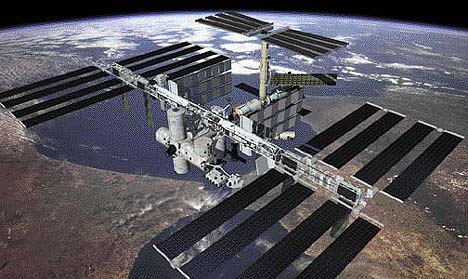
International Space Station – for your viewing pleasure.

The International Space Station The International Space Station will be a special treat for all of us in Southern California over the next several days. We will have some truly spectacular “fly-overs” for some of the brightest passes theoretically possible (the brightness is determined by how the space station – and particularly their football-pitch sized solar panels – happen to be aligned with the sun).

For those of you who may be new to viewing it the ISS will be visible as one of the brightest (mostly the brightest) star-like object in the sky as it passes approx 200 miles overhead at over 17000 mph. The table below gives a lot of information about each visible pass including when and where to look.  The lower the Mag number the brighter the ISS will be.  So for example the pass on April 8th starting at approx 7:54pm will be one of the brighter ones.

Be sure to wave to the SIX astronauts who are calling the ISS home right now.

Unusual (for me) is to post the times when the ISS will be passing over just before sunrise. I’m likely going to be asleep – but hopefully those of you who are early birds might enjoy the opportunity.

Click on the date for each pass for further detail.

Date Bright Start Highest point End
[Mag] Time Alt. Az. Time Alt. Az. Time Alt. Az.
06 Apr -2.4 19:59:31 10° SSW 20:02:23 28° SE 20:04:56 12° ENE
07 Apr -2.0 20:45:06 10° WSW 20:48:14 41° NW 20:50:40 15° NNE
08 Apr -3.3 19:54:17 10° SW 19:57:34 86° NW 20:00:51 10° NE
09 Apr -0.4 20:41:23 10° WNW 20:43:41 18° NNW 20:45:59 10° NNE

All of the predictions above provided by Heavens-Above.com where you can get your own predictions for this and many other neat things to see in the sky above you.

The International Space Station visible to Southern California in the evening for next few days

The International Space Station The International Space Station will be a special treat for all of us in Southern California over the next several days. We will have some truly spectacular “fly-overs” for some of the brightest passes theoretically possible (the brightness is determined by how the space station – and particularly their football-pitch sized solar panels – happen to be aligned with the sun).

For those of you who may be new to viewing it the ISS will be visible as one of the brightest (mostly the brightest) star-like object in the sky as it passes approx 200 miles overhead at over 17000 mph. The table below gives a lot of information about each visible pass including when and where to look.  The lower the Mag number the brighter the ISS will be.  So for example the pass on Wednesday Feb 27 starting at approx 6:22pm will be one of the brighter ones.

Be sure to wave to the SIX astronauts who are calling the ISS home right now.

Click on the date for each pass for further detail.

Date
Bright
Start Highest point End Pass type
[Mag] Time Alt. Az. Time Alt. Az. Time Alt. Az.
26 Feb -2.5 19:12:29 10° WNW 19:15:44 49° SW 19:16:47 34° S Visible
27 Feb -3.3 18:21:46 10° NW 18:25:07 76° NE 18:28:27 10° SE Visible
28 Feb -0.4 19:08:36 10° W 19:10:46 16° SW 19:12:55 10° SSW Visible
01 Mar -1.4 18:17:13 10° WNW 18:20:14 32° SW 18:23:16 10° SSE Visible

All of the predictions above provided by Heavens-Above.com where you can get your own predictions for this and many other neat things to see in the sky above you.

Starting 2012 strong – the International Space Station – a treat for all in Southern California.

The International Space Station
The International Space Station will be a special treat for all of us in Southern California over the next several days. We will have some truly spectacular “fly-overs” where the station will be perfectly aligned with the sun for some of the brightest passes theoretically possible.

For those of you who may be new to viewing it the ISS will be visible as one of the brightest (mostly the brightest) star-like object in the sky as it passes approx 200 miles overhead at over 17000 mph. The table below gives a lot of information about each visible pass including when and where to look.  The lower the Mag number the brighter the ISS will be.  So for example the pass on Monday 2 Jan at 6:17pm is the brightest one in the list at -3.4.

Click on the date for each pass for further detail.

Date Mag Starts Max. altitude Ends
Time Alt. Az. Time Alt. Az. Time Alt. Az.
2 Jan -3.4 18:17:27 10 NW 18:20:38 58 NE 18:20:51 56 ENE
3 Jan -2.2 17:21:07 10 NNW 17:23:55 26 NE 17:26:40 10 E
3 Jan -1.0 18:57:25 10 WNW 19:00:00 22 SW 19:00:24 22 SW
4 Jan -2.7 18:00:18 10 NW 18:03:28 57 SW 18:06:36 10 SSE
5 Jan -3.2 17:03:37 10 NW 17:06:49 53 NE 17:09:57 10 ESE
5 Jan 0.4 18:42:17 10 WSW 18:42:35 10 SW 18:42:53 10 SW
6 Jan -0.7 17:43:24 10 WNW 17:46:06 24 SW 17:48:45 10 S
8 Jan 0.9 17:27:28 10 WSW 17:28:31 11 SW 17:29:32 10 SW
11 Jan 0.0 06:30:38 10 S 06:32:58 18 SE 06:35:18 10 E

All of the predictions above provided by Heavens-Above.com where you can get your own predictions for this and many other neat things to see in the sky above you.